About three months ago, I started FourType as a fun project. I wanted to help people understand their temperament and the people around them.
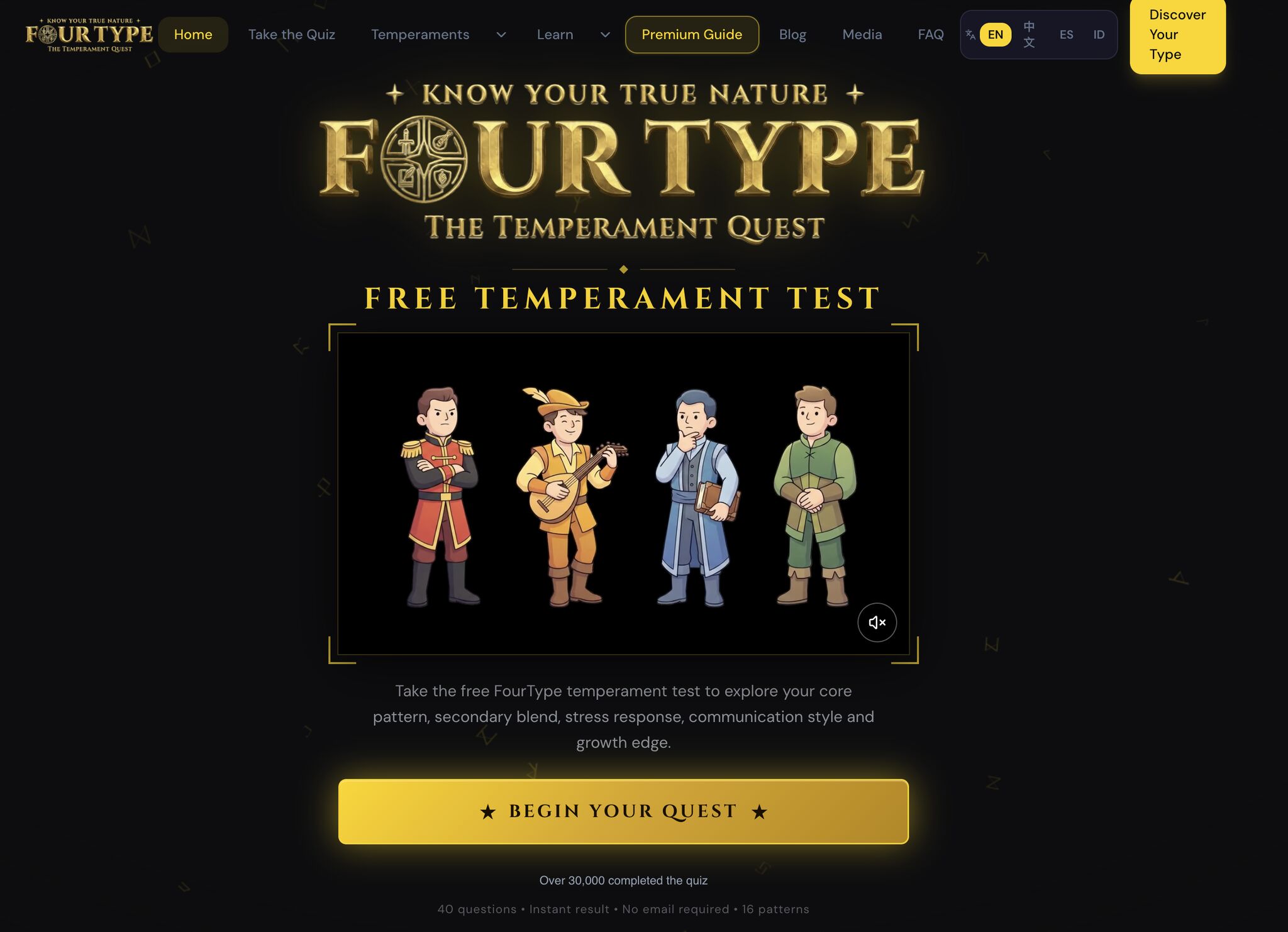
The site has a free 40-question quiz. People get their results right away, without giving us an email address. The results draw on four classic temperaments and 16 profiles, including blends.
I think a temperament test is most useful when it gives someone a fresh way to think about a familiar habit.
Maybe you make decisions quickly, need time to consider every angle, or try to smooth things over when a conversation gets tense. A result can help you reflect on those patterns and understand why someone else might react differently. It is a prompt for self-reflection, not a diagnosis or a full account of who someone is.
FourType calls the four patterns Choleric, Sanguine, Melancholic, and Phlegmatic.
The characters are the Commander, Bard, Strategist, and Guardian. A Commander tends to be direct and ready to act, while a Bard often brings energy and expressiveness.
A Strategist likes to think things through, and a Guardian tends to bring patience and steadiness. People may recognize themselves in more than one.

The latest 30-day analytics snapshot showed 10,326 visitors and 28,972 page views, with no ad spend.

In Search Console’s three-month view, Google showed FourType 340,000 times and sent 7,610 clicks. The click-through rate was 2.2%, and the average position was 8.5. More than 20 people have paid for the Field Guide
What the traffic is telling me
About 4,200 visitors reached the quiz page in that analytics snapshot.
The homepage had around 1,200. The blog and individual temperament pages brought people in too. The quiz is the main destination, but those other pages matter because someone may first arrive with a specific question and need a little context before taking a test.
An average Search Console position of 8.5 puts the results roughly in the lower part of page one across the impressions counted. It doesn’t tell me where every query ranks, or which search terms bring the right visitors. So I don’t want to chase rankings in the abstract. I want to see which relevant queries already lead people to FourType and which pages could answer those searches better.
Scaling LLM is something I’ve been focusing on.
That gives me an AI referral source to track, while search remains the larger distribution channel in the data I have.


How I plan to scale distribution
The first step is to work from existing demand. I’ll review Search Console by query and landing page, then focus on searches that are relevant to FourType and already show impressions. For each one, I want to check whether the page answers the searcher’s question clearly, whether the title accurately reflects the page, and whether there’s a useful next step.
That should help me choose what to improve before I decide what to publish next. FourType already has pages about the temperaments and their blends. I can make those pages more useful, connect related topics with internal links, and make it easier for someone to move from learning about one pattern to taking the quiz when they’re ready.
I also want each page to work for people who arrive from AI answers. That means stating the answer clearly, explaining FourType’s framework in plain language, and linking to the relevant quiz or guide. The 140 ChatGPT referrals show that some people are arriving this way.
I’ll track whether that source grows and what those visitors do, without assuming that a small referral count predicts a trend.
Social can help extend the useful parts of the work beyond the site. Rather than posting the same promotion everywhere, I can turn a real insight from an article or the product into a platform-appropriate post, then link back when it adds context. On LinkedIn and X, that can include what I’m learning while building FourType. In discussion communities, the useful contribution should come first, with the site link only where it helps answer the question.
The distribution loop I want is clear: a page answers a real question, the quiz gives the visitor a personal result, and the Field Guide offers more depth for people who want it. Then the questions and behavior I see can guide the next page or product improvement. That gives me a way to grow organic discovery without relying on ad spend.
What I need to measure next
What I have not figured out yet is what happens between reaching the quiz page and buying the guide. I need to know how many people start the quiz, how many finish it, and how many continue to the Field Guide.
About 71% of visitors in the snapshot were on mobile. My hypothesis, not a finding, is that mobile visitors may be less likely to finish the 40-question quiz.
I’ll track quiz starts and completions by device and compare the rates.If mobile completion is similar to desktop, I’ll look at the path from quiz results to the Field Guide instead.
You can take the free FourType quiz or read the Field Guide.