How capable employees and founders become indispensable to the work while leaving themselves little room to grow.
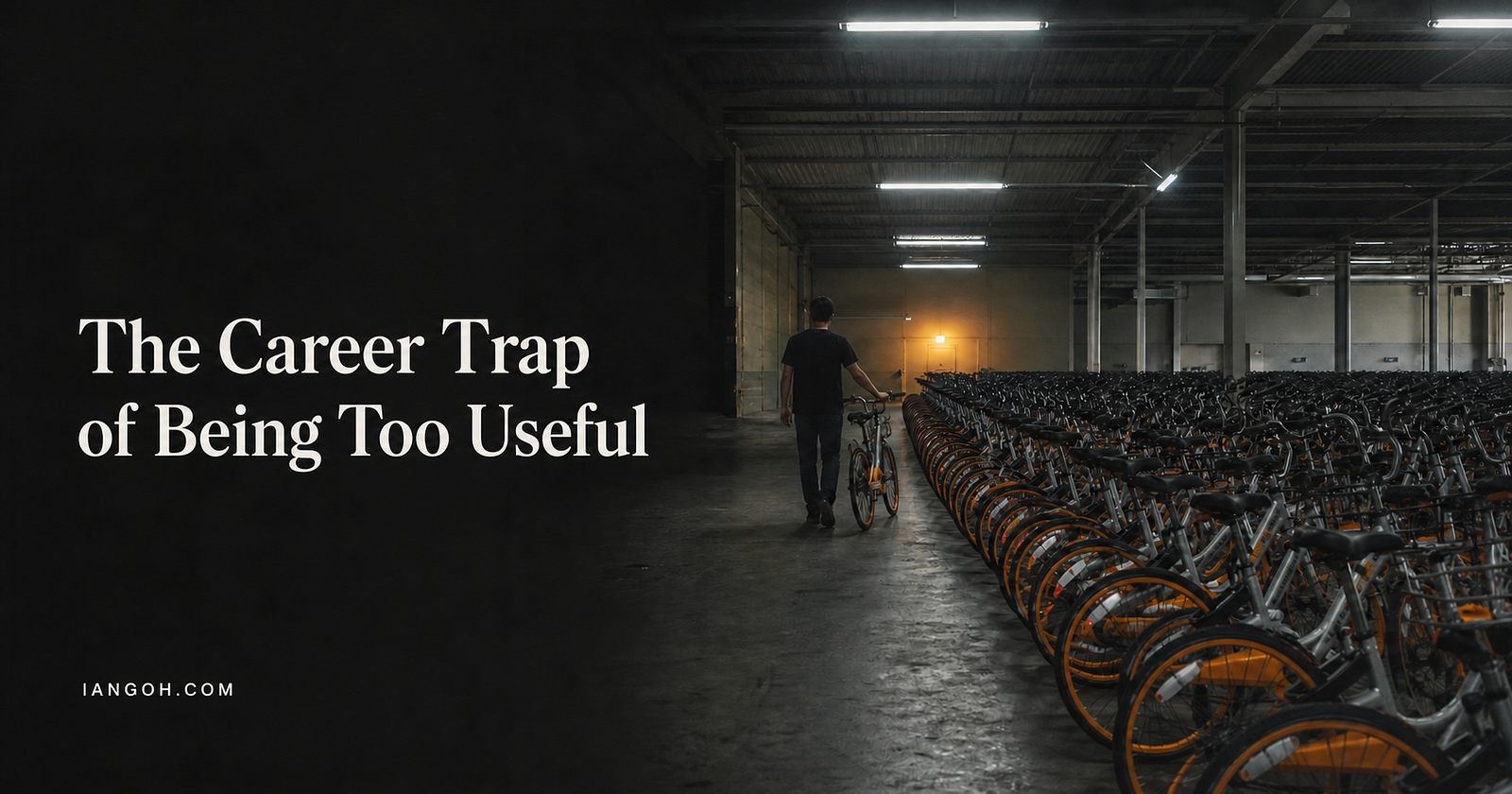
My first week at a bike-sharing startup began in a warehouse full of bicycles.
The instruction was simple: get them into the city.
So I went with my father to meet the local authorities. I pitched a university, cold-called hotels and shopping centres, and waited outside an office to meet the mayor. One hour I was making slides. The next I was moving bikes or trying to turn an enthusiastic conversation into a real location.
There was no playbook and little separation between roles. If something needed doing and I could help, I did it.
People noticed. They trusted me with more.
That was how I learned the power of being useful.
It was also how I eventually learned the danger.
When usefulness feels like growth
I had left home for a city I had not really wanted to move to. Some days I slept in the car between meetings. At night, work followed me into my dreams.
Still, I loved it.
The mission was visible. Every conversation could unlock a location. Every partnership could put bikes on the ground. Every obstacle forced us to choose what to do next.
My confidence grew meeting by meeting. I went from hoping people would take me seriously to walking into rooms knowing I could answer their questions. Within months, I was helping build a team, planning expansion, dealing with government stakeholders, and carrying responsibilities far beyond my original title.
My journal from that period swings between exhilaration and exhaustion, sometimes in the same entry.
But I felt alive because I was close to the result.
A pitch became permission. Permission became a deployment. A deployment created data, attention, and another problem to solve.
The work kept asking more of me. Not only more hours, but better judgment. I had to read a room, understand what an institution was worried about, decide where to push, and accept the consequences when I got it wrong.
That was ownership before I had a word for it: choosing what happened next and carrying the result.
This was the kind of work I kept searching for later: an unclear route, a visible result, and enough room to affect what happened next.
Being useful accelerated my career because every problem gave me a new ability to develop.
Then that relationship began to change.
The day speed outran permission
During that first week, a university gave us verbal support. We were moving quickly and wanted to prove that the model could work. So we deployed a large batch of bikes on campus before the approval had been put in writing.
For a brief moment, it felt like progress. The bikes were on the ground. We had stopped talking and started moving.
Then the call came.
Remove them, we were told, or they would be locked up.
I remember how quickly excitement turned into dread. We had treated a positive conversation as permission. All the hustle in the world could not turn friendly words into an agreement that did not exist.
That mistake mattered because I had built part of my identity around moving fast. I admired people who found a way around obstacles and refused to wait for perfect conditions. I still do.
But speed does not excuse carelessness. You can be right about the opportunity and still wrong about what you are allowed to do next.
Real responsibility includes boundaries. You need to know which decision is yours, which decision belongs to somebody else, and what trust you are risking when you move.
The lesson was uncomfortable. I had thought usefulness meant seeing what needed to happen and making it happen. Now I understood that good work also required patience, agreement, and respect for decisions I did not own.
It would not be the last time my ability to move became both a strength and a problem.
When the mission starts using you
Then the company started to fail.
At first, we were opening doors. Later, more of our time went into keeping doors from closing.
Direction changed. Pressure grew. The future turned uncertain, but the local work did not stop. There were still partners to manage, a team to steady, and commitments already made.
So I kept moving.
That was what I knew how to do. When something broke, I found another route. When the team felt anxious, I tried to give them confidence. When the wider story grew harder to believe, I focused on the next meeting and the next small win.
For a while, usefulness gave me something solid to hold.
It also delayed a harder truth. No amount of local hustle could repair decisions made far above us. I could protect the team from some uncertainty, but I could not give the company a future. I could keep partnerships warm, but I could not restore a strategy that was disappearing.
The same qualities that had helped me grow were now helping me endure a system I could not change.
That is the cruel part of being capable. You do not leave when the system weakens. You compensate for it.
You carry more because people still need you. You solve one more emergency because walking away feels like abandonment. You keep the machine running, and the fact that it still runs becomes evidence that perhaps things are not as bad as they seem.
But sometimes the machine is only running because you have agreed to absorb the damage.
I did eventually leave. The harder part was not finding another job. It was accepting that loyalty to the people did not require pretending the company could still grow us.
Sometimes staying is commitment. Sometimes it is grief that has not yet learned how to let go.
Important work without meaningful influence
Years later, the work looked more sophisticated.
The problems were larger. The numbers were regional. The decks were cleaner. I had enough experience to walk into a meeting, read the performance, and explain why something was happening.
I could tell the room where growth was slowing, which group was underperforming, and what pattern the data suggested. I learned to turn a complicated system into a coherent story.
This was useful work. Leaders need someone who can see the shape of a problem.
But I started leaving meetings with an uneasy feeling.
Everyone understood the diagnosis. Then the choices that could change the result travelled somewhere else.
I could explain why the number moved, but I could not change the offer. I could identify what the team needed, but I could not redirect the resources. I could recommend a test, but I was not always the person who could approve it.
Nothing dramatic happened. Nobody told me I had failed. In many ways, I was doing the job well.
That was precisely the problem.
I was very good at narrating results I was not empowered to change.
Explanation can feel like control. A polished deck can make a room feel productive because the confusion has been organised. But the number does not move because the story grew clearer.
Eventually, I had to ask myself a harder question:
Am I describing the business, or am I changing it?
Instead of ending with what happened, I began pushing toward what decision should follow. What could move the result? Who was allowed to choose? What could we test? When would we know if it worked?
Reporting ends with an answer. Ownership ends with a decision.
Ownership, in this sense, is not a title. It is the room to choose what happens next and the responsibility to live with what your choice produces.
An answer can be admired and forgotten. A decision puts someone on the hook.
The trap of being too useful
I kept solving the problems in front of me until I realised the company had stopped giving me new problems to grow into.
That is the trap.
When you know the client history, every difficult account comes back to you. When you understand the numbers, every performance question lands on your desk. When you are good in a crisis, people call you whenever something breaks.
You can always find a way, so the organisation never has to build a better way.
At first, this feels like security. People praise your reliability. Your calendar proves that you matter. You are difficult to replace.
Meanwhile, the work changes very little. You solve familiar problems under greater pressure. Your workload rises while your learning flattens.
The organisation gets what it needs from the person you already are. It has little reason to create room for the person you could become next.
This arrangement is rarely malicious. You helped build it. Every time you rescued the work without asking what should change, you taught people to bring the same work back to you.
The question is not simply, “Do they appreciate me?”
Ask, “What am I being valued for?”
One question helped me see the difference: am I here to advise, or decide?
Are you trusted to carry more work, or trusted to make better decisions? Does the role keep stretching your judgment, or are you getting faster at cleaning up the same mess?
Being needed can look like career growth for a very long time.
Founders can become too useful too
Founders can build the same trap around themselves. Every decision returns to them, every emergency needs their attention, and the business never learns to think without them.
If the company cannot operate without your constant intervention, you may own it, but it still owns your attention.
Moving tasks to other people will not solve this. The real work is transferring decisions. Someone else needs enough context to choose, clear limits, and time to experience the consequences. Nobody learns judgment while every meaningful choice is pulled back to the founder.
The uncomfortable truth is that being indispensable can feel flattering. It can also be evidence that the company has stopped growing beyond your personal capacity.
A business grows when more people can change the result without waiting for one person to enter the room.
Test the role before you leave it
Restlessness is not always wisdom. Sometimes you have outgrown the work. Sometimes you are tired, bored, under-supported, or frustrated after a bad month.
Before turning that feeling into a resignation letter, run a 30-day test.
- Choose one result. Pick something narrow enough to measure, such as one customer group, repeated problem, or business result that everyone agrees matters.
- List the decisions behind it. Write down what needs to change and who is currently allowed to choose. This often reveals that a supposed performance problem is really a decision problem.
- Ask for clear permission and resources. Agree on what you can decide, what support you have, and where the limits sit. You do not need unlimited freedom. You need enough room to affect the result.
- Set a review date. Decide what evidence will count and what you will do if nothing changes. Do not let one hopeful conversation turn into another six months of waiting.
- Watch what happens. Judge the organisation by what changes after the conversation, not by what it promises.
If you receive room to operate and remain disengaged, the issue may be deeper than the role. If the company wants the result but refuses to let you influence it, that is an answer too.
Leaving may still be right. But now you are responding to evidence rather than escaping a feeling.
What I wish I had understood earlier
On the first day of my first real job, years before the warehouse, I was asked to help develop a new childcare project.
Nobody asked me to write a marketing plan. I wrote one anyway.
I researched the permits, visited the planning office, and earned more trust because I tried to make myself useful.
That instinct opened my career.
It just could not be the whole career.
Initiative creates opportunity. But growth eventually requires more than another task, another emergency, or another reason for everyone to depend on you.
It requires decisions that stretch your judgment. It requires room to try, to be wrong, and to carry the result. It requires work that develops something in you instead of merely consuming what you already know.
There will always be tasks that simply need doing. Not every season needs to feel like a major leap forward. Patience matters, and so does learning to work within limits.
But a career cannot survive forever on usefulness alone.
At some point, you need to know whether the place that benefits from your present ability has any interest in your future ability.
The salary arrives. The work gets done. People say thank you. Another quarter passes.
And slowly, being needed begins to replace becoming.
Do not confuse the two.